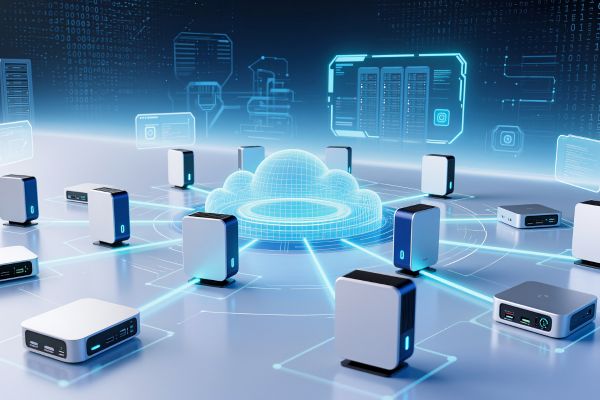
Modernize infrastructure to enhance performance, security, scalability, and support emerging technologies through virtualization, automation, and cloud integration.
Network transformation ensures your infrastructure can handle the increased data traffic without compromising performance.
Enchanced performance and efficiency
A transformed network delivers optimal performance, reducing latency, and improving application responsiveness. This translates to increased productivity and a better user experience.
Cost Reduction and energy saving
Modern network technologies offer energy-efficient solutions, helping you reduce operational costs while minimizing your environmental impact.
Support emerging technology
Network transformation ensures your business is ready to support these innovations, staying ahead of the technological curve.
Operational Agility
A flexible and adaptable network empowers your business to respond quickly to changing market conditions and business needs.
Advanced network Architecture
Enterprise Resourse Planning
Integration and Network Managenent System
Cost and Budgeting
Procurement Management
Deployment and Configuration
Reliability and Upgradation
Life cycle Management
Network virtulization
Remote access and connectivity
Simplified Network Management
Manpower Reduction
Reduced Hardware Failure
Easy Troubleshooting
Simplified Network Expansion
Network Automation
Configuration Management
Network Monitoring and Performance Monitoring
Provisioning and deployment
Security Management
Backup and Disaster Recovery
Data Analysis, User Experience Improvement and Secure eco system
Telemetry and Logging: Collecting detailed telemetry data for real-time monitoring and analysis.
Network Analytics: Using advanced analytics tools to gain insights into network performance and usage patterns.
Enhanced User Interfaces: Providing intuitive and user-friendly interfaces for network management.
Self-Service Portals: Enabling users to manage network resources and services independently.
Vendor Partnerships: Collaborating with technology vendors to leverage the latest innovations.
Open Standards: Adopting open standards for better interoperability and future-proofing the network.
Cloud and edge Computing
Hybrid Cloud: Seamlessly integrating on-premises infrastructure with public and private clouds.
Edge Devices: Using devices like IoT gateways to perform data processing at the network edge.
Infrastructure Modernization and Network Function virtualization (NFV)
Upgrading Hardware: Implementing newer, more efficient routers, switches, firewalls, and servers.
Virtualizing Network Services: Replacing dedicated hardware appliances with virtualized versions that run on standard servers.
Service Chaining: Creating flexible service chains to route traffic through multiple virtual network functions (VNFs).
SD-WAN Software defined NEtworking
Separation of Control and Data Planes: Decoupling network control from forwarding functions to enhance flexibility.
Centralized Network Control: Using a centralized controller to manage the entire network.
Programmability: Enabling network programmability for more dynamic and efficient traffic management.
Let's Build a Smarter and More Secure Network for Your Business
Ready to transform your business with reliable technology solutions? Get in touch with our experts today.